

What Is Merino Wool? A Guide to Wearing and Caring for It
Written by Eleven Loves
Merino wool is the fine, soft wool of the merino sheep, a breed developed in Spain and now farmed mainly in Australia. Its fibres are much finer than those of ordinary wool, so a good merino knit feels smooth rather than scratchy against the skin. It is also naturally breathable, which is why a fine merino layer keeps you warm without bulk and without overheating indoors.
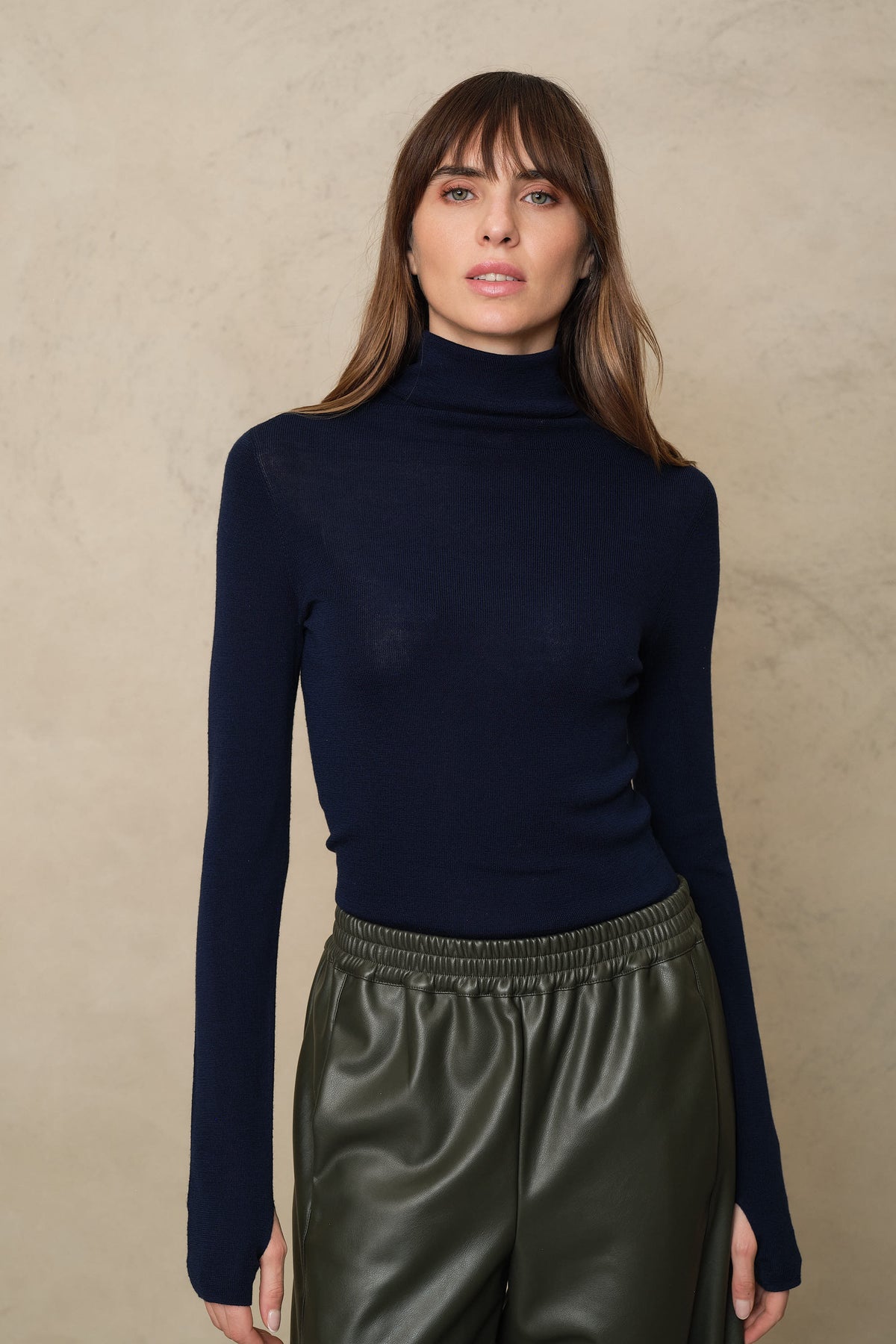
Both of our merino styles, the Gwyneth roll neck and the Trinny crew neck, are knitted in 100 percent ultrafine merino wool. This guide explains what merino is, where it comes from and why fine merino does not itch. It then covers how merino compares with cashmere and lambswool, how to wear it through autumn and how to wash it so that it keeps its shape.
What is merino wool made from?
Merino wool is shorn from the fleece of the merino sheep. Like all wool, it is a natural protein fibre made mostly of keratin, which is also the protein in human hair. What sets merino apart is the width of each fibre: according to the Woolmark Company, merino is generally finer than 22 microns, while a human hair measures between 50 and 100 microns.
That fineness shapes how a merino knit feels and behaves. Fine fibres are soft and pliable, so they bend against the skin instead of pressing into it, and they spin into a smooth yarn that knits to a close, fine gauge. Each fibre also has a natural crimp, a gentle wave along its length, which traps air for warmth and gives the knit its stretch and recovery.
You will see merino sold as fine merino, extra fine merino wool, superfine or ultrafine, and each grade sits further along the micron scale, so the finer the grade, the softer the knit. Superfine merino measures less than 18.5 microns, and ultrafine, the grade our Gwyneth and Trinny are knitted in, is finer still.

Where does merino wool come from?
Merino sheep were developed in Spain, where their fine wool was highly prized for centuries. In 1797 the first merino sheep, descended from the royal merino flocks of Spain, arrived in Australia, and selective breeding there went on to produce an even finer fibre. Australia now provides 81 percent of the world's superfine wool, according to the Woolmark Company.
Is merino wool itchy?
Fine merino is not itchy, and there is a simple physical reason for it. The prickle people associate with wool happens when coarse fibres, those thicker than about 30 microns, press against the skin instead of bending. Merino fibres are far finer than that, so they flex softly on contact, which is why a good merino knit can be worn with nothing underneath.
The Woolmark Company notes that superfine and ultrafine merino bend easily against the skin, which helps to minimise irritation for people with sensitive skin. Our founder, who is sensitive to itch herself, finds the ultrafine Gwyneth not at all itchy.
The same fineness answers the most common hesitation about roll necks, which is that they feel tight or scratchy at the throat. A fine merino roll neck is light enough to feel closer to a base layer, and the soft, easy roll on the Gwyneth sits at the neck without gripping.
Is merino wool warm?
Merino is warm for its weight, because the crimp in each fibre holds still air close to the body. A fine merino knit therefore insulates far better than its thickness suggests, which is why it can go under a coat or a blazer without adding bulk.
It also copes well with the changes of temperature in an autumn day. Wool absorbs moisture vapour, and according to the Woolmark Company it can take up to 35 percent of its own weight before it feels wet. On a warm train or in a heated office, that means a merino layer takes up the dampness instead of leaving you clammy.
That balance of warmth and breathability is why merino is useful for most of the year, worn on its own on a mild day and as a warm first layer when the cold arrives.
How does merino compare with cashmere, lambswool and ordinary wool?
Merino wool vs cashmere
Cashmere is the soft undercoat of the cashmere goat, while merino is the fleece of the merino sheep. Cashmere is softer, lighter and warmer for its weight, which is why it has long been the luxury fibre. Merino is harder wearing, easier to wash and better at managing moisture, which makes it the more practical everyday layer. The two work well together, and a fine merino roll neck under a cashmere blend jumper is one of the warmest ways to dress without bulk. Our guide to what cashmere is covers that fibre in more detail.
Merino wool vs lambswool
Lambswool describes when the wool was shorn rather than the breed it came from. It is the first clip from a young sheep, at around seven months old, which makes it softer than wool from older sheep. Merino describes the breed, and fine merino is usually smoother still, with a flatter finish, while lambswool has a loftier, more rustic handle that suits a chunkier knit.
Merino wool vs ordinary wool
Wool from most other breeds has a thicker fibre, which gives traditional knits their structure and warmth and also their prickle. Merino knits into a lighter, closer fabric that drapes against the body, so it gives the warmth of wool without the width of a heavier jumper.
Where merino fits in an autumn knitwear wardrobe
A fine merino knit is the first and lightest step in an autumn knitwear wardrobe, and the chunky jumpers come much later. Hayley Thomas, our founder, explained it this way in her video on autumn styling mistakes: "Getting autumn knitwear right is about moving up the weights. So September is your fine merino, thin enough to get a shirt under and a jacket over and still sit through a meeting in it."
After merino comes a lightweight cashmere blend such as the Alex Cashmere Blend Jumper or the Nian V-Neck Cashmere Blend Jumper, then a heavier cable knit. A chunky jumper such as the Bea Funnel Neck Jumper is best saved for the coldest two or three months. Until then, it is more useful worn round the shoulders, which brings its colour and texture into the outfit without the heat.
Light layers are also more useful than bulky ones for making outfits. A merino roll neck worn under the Cora Alpaca Blend Short Sleeve Striped Jumper shows its full sleeve below the Cora's short one, which makes the layering look deliberate and adds a second texture. There is more on building an outfit in layers in our guide to layering clothes for warmth and style.

How to wear merino wool
Most merino wool outfits start from the same idea. A fine knit sits close to the body, so it works as the neat half of the outfit, whether that is under tailoring, above a wide or barrel leg, or in one colour from top to toe.
Merino under a blazer
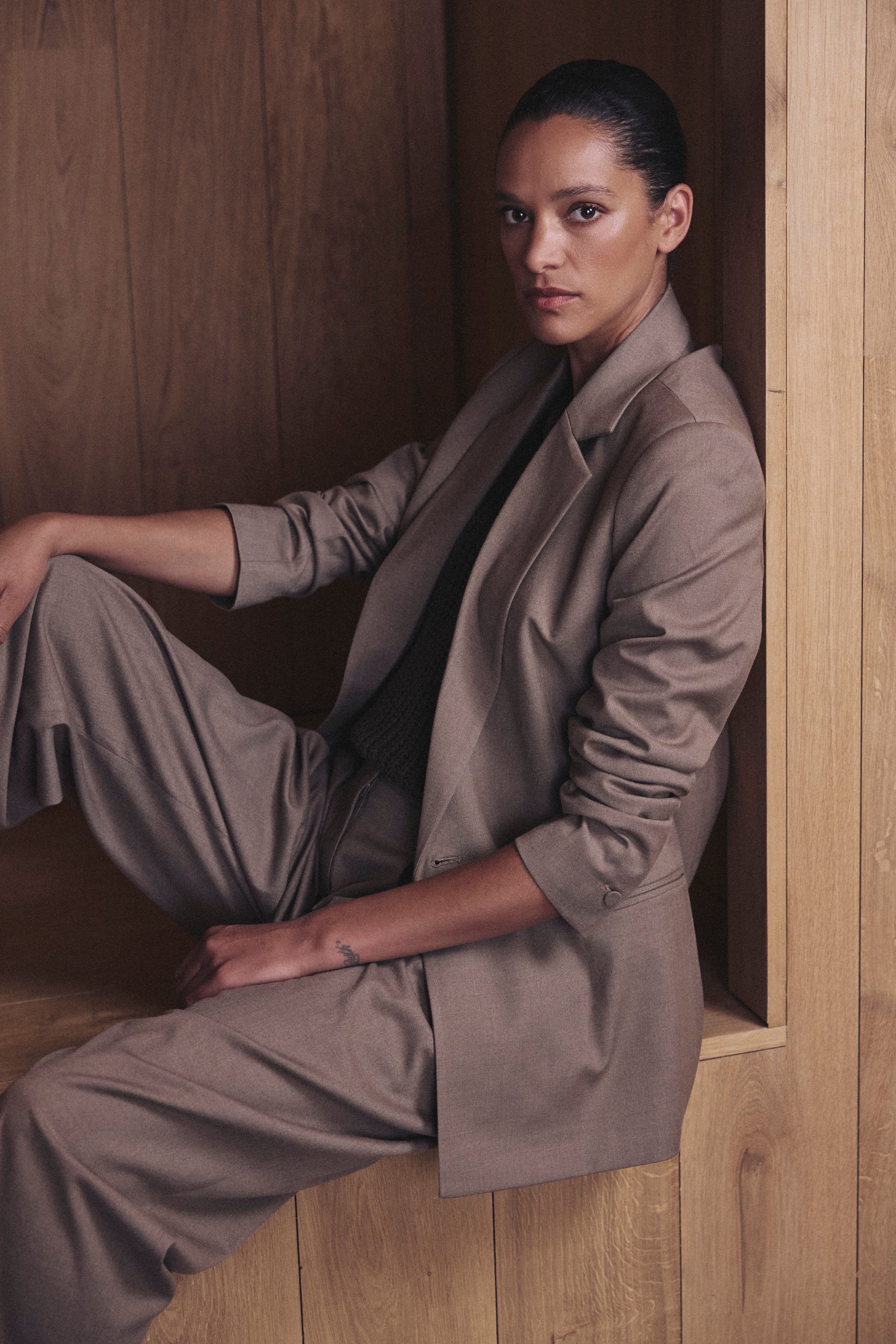
Under tailoring, a fine merino roll neck keeps the line clean at the collar and shoulder and softens the formality of a suit. The Georgia Double Breasted Blazer in navy pinstripe over a black Gwyneth Fine Merino Roll Neck puts something soft in the knit against something sharp in the tailoring. The matching Dora Wide Leg Trousers turn it into a full suit, while the Teyha Tweed Blazer in houndstooth gives the same idea a more French feel, particularly with a black roll neck.
The optional thumb holes on the Gwyneth disappear when they are not in use, so the same knit can go to the office and then into the weekend.

Merino with wide and barrel leg trousers
A neat top is the simplest way to balance volume on the bottom half, and fine merino sits close to the body without clinging. The Trinny Fine Merino Crewneck in camel tucked into the Billie Barrel Leg Trousers in ecru keeps the shape of the trouser clear. The Gwyneth in charcoal does the same with the Billie Barrel Leg Faux Leather Trousers in olive, and for a wide leg, the black Gwyneth with the Frankie Wide Leg Jeans in black makes a long, unbroken line.
Stylist Claire Lopez made a related point on our AW26 Live: soft, fluid yarns such as merino and cashmere drape around the body instead of adding width, which is why they work across so many body shapes. Our guide to how to style barrel leg trousers covers the shape itself in more detail.

Merino in one colour from top to toe
Matching a knit to the skirt or trousers beneath it gives the polish of a suit without any tailoring. A navy Gwyneth or Trinny with dark denim, such as the Imogen Denim Skirt in dark wash, creates one long column of colour. The charcoal Gwyneth does the same with grey, for a polished everyday look.
Merino in colour
The Trinny is designed for anyone who likes colour but would rather not think too hard about combining it. Each one pairs a body colour with a contrast cuff, so the outfit is built around the body colour while the cuff adds a small second note. The Trinny in bottle green with a navy cuff sits well with dark denim, and the Gwyneth comes in brighter single shades too, including red, mustard and sky blue.

How should merino knitwear fit?
Fine merino looks best with a neat fit, close through the body without clinging. Both the Gwyneth and the Trinny are cut this way and are true to size, and both are knitted as a seamless tube, with a discreet side seam in sizes 16 and 18. If you are between sizes, we suggest the larger one, because it still sits neatly and leaves room for a vest underneath when the weather turns.
How to wash merino wool
Merino wool care is simpler than most people expect, as long as the knit is washed cool and gently and dried flat. Our merino knits can be hand washed or washed on a gentle wool cycle at 30 degrees, and the care label is always the final word.
- Merino rarely needs washing after a single wear, because the fibre naturally resists odour, so airing it between wears is often enough.
- A hand wash, or a gentle wool cycle at 30 degrees with the knit turned inside out, keeps the surface smooth.
- A detergent made for wool or delicates is the safest choice for a protein fibre.
- Wringing or twisting stretches the knit, so it is better to press the water out gently or roll the jumper in a clean towel.
- Reshaped while damp and dried flat, away from radiators and direct sun, merino keeps its size and shape.
- Tumble drying is the one thing to avoid, because heat and movement together are what shrink wool.
- A cool iron or a little steam is enough if it needs smoothing.
Does merino wool shrink?
It can, when heat and agitation meet. Each wool fibre is covered in tiny overlapping scales, and hot water combined with tumbling makes them lock together, which felts and shrinks the knit. Washed cool, handled gently and dried flat, merino keeps its size.
Does merino wool bobble?
A little bobbling where a knit rubs, under the arms or at the cuffs, is normal in the first few wears as loose fibres work their way to the surface. A fabric comb lifts them off, and the bobbling usually settles once those loose fibres have gone.
How to store merino
Knitwear is best folded, because the weight of a knit stretches it out of shape on a hanger. It should also be put away clean, since moths are drawn to knits stored after wearing, and our cashmere care guide covers moths and storage in more detail, with the same rules applying to merino.
Our merino knits
Both of our merino styles are knitted in 100 percent ultrafine merino wool and made in small runs. The Gwyneth Fine Merino Roll Neck has a soft, easy roll neck and optional thumb holes, and comes in eleven colours, from black, navy and charcoal to red, mustard and sky blue. The Trinny Fine Merino Crewneck uses the same yarn with a crew neck and a contrast cuff, in nine colourways. You will find both in our merino wool jumpers collection.
Merino wool questions, answered
Is merino wool itchy?
No. Itch comes from coarse fibres thicker than about 30 microns pressing into the skin, and merino fibres are far finer, so they bend softly instead. Most people can wear fine merino next to the skin, including many who find ordinary wool scratchy.
Is merino wool warm?
Yes. The crimp in each fibre traps air, so merino is warm for its weight, and because it absorbs moisture vapour it keeps you warm without overheating.
How do you wash merino wool?
By hand, or on a gentle wool cycle at 30 degrees with a detergent made for wool. Reshaped and dried flat, and never tumble dried, it keeps its size and shape.
Does merino wool shrink?
Only with heat and agitation together. Washed cool and gently and dried flat, merino keeps its size.
Is merino wool good for summer?
A fine merino knit breathes and regulates temperature, so it is comfortable well beyond winter, on cool summer evenings and through the in-between weeks of spring and autumn.
Is merino wool better than cashmere?
Neither is better, because they do different jobs. Merino is harder wearing, easier to wash and better at managing moisture, which makes it a practical everyday layer, while cashmere is softer and warmer for its weight.

Leave a comment
This site is protected by hCaptcha and the hCaptcha Privacy Policy and Terms of Service apply.